Showing posts with label Toyota. Show all posts

Monday, May 13, 2013

Toyota Auris, 2013


  •  Toyota Auris, 2013

Representing the first step in Toyota's product offensive in the European C-Segment, the new Toyota Auris is bolder, more dynamic, better equipped and cheaper to run than ever before.

The new Auris reflects Toyota's determination to engineer more appealing, dynamically engaging cars and builds on a long-established reputation for quality, durability and reliability

It offers bolder, more confident and sleek styling, a higher quality interior design, improved driving dynamics and further enhancements to the technical leadership of its flagship, full hybrid model.

Aerodynamic improvements, weight savings and engine enhancements have seen fuel consumption and CO2 emission reductions across the range, further lowering running costs and the Total Cost of Ownership.

Toyota is the world's leading producer of C-segment vehicles, with 39 million units sold in over 140 countries since the introduction of the Corolla in 1966. The launch of the Toyota Auris Hybrid in 2010 made Toyota the first manufacturer to offer a choice of three powertrains in the C-segment.

Designed for the European market, its largest volume market, the new Auris will be built at Toyota Motor Manufacturing UK alongside the Avensis, reinforcing the company's commitment to its European operations.

TMUK celebrates its 20th anniversary this year with 3,265,000 vehicles produced since start of operations in 1992. Toyota Auris production currently stands at some 418,000 units.

Improved Packaging
At 4,275 mm the overall length of the new Auris has increased by 30 mm, though its wheelbase remains the same at 2,600 mm. The front and rear overhangs have both increased by just 15 mm, and the Auris remains one of the most compact cars in its class.

Significantly, the frontal projected surface area of Toyota Auris has been reduced by 4% over the current model and, without impacting on passenger accommodation, its overall height lowered by 55 mm (the cabin by 45 mm and the ride height by 10 mm), making it one of the lowestvehicle in the segment. In combination, these changes offer considerable aerodynamic benefits, contributing to improved fuel efficiency and driving dynamics.

The extensive use of high tensile steel in the bodyshell construction has helped to reduce the overall weight of the new Auris by up to 40 kg, whilst its overall reduction in height has also lowered the centre of gravity. The seat height has been reduced by 40 mm and the steering wheel tilt angle lowered by 2 degrees, creating a more engaging driving position with a low hip point.

A new front seat design increases rear seat knee room by 20 mm, and the rear door opening width has been enlarged. The loadspace length has been increased by 50 mm and the tailgate opening width increased by 90 mm. Featuring the added flexibility of a dual-level loadspace deckboard and 60:40 split-folding rear seats, all versions, including the hybrid, offer an increased luggage capacity of 360 litres.

More Dynamic Exterior Design
Designed to maximise the benefits of a reduced overall height and lower centre of gravity, the new Auris features an all-new exterior with more confident, sleek, and dynamic styling.

Nowhere is the next generation Toyota Auris' confidence and agility more immediately apparent than in its new frontal design. The new face of Toyota combines the company's Under Priority grille design style with Keen Look headlamp and LED Daytime Running Light (DRL) detailing to bring boldness to the Auris range, and a markedly more powerful road presence.

The Under Priority design features a large, trapezoidal lower grille set within the front bumper, and a smaller upper grille running full width between the new headlamps.

Beneath a low sweeping bonnet line dominated by a new, larger Toyota badge which is set lower than its predecessor, the upper grille features a central, chrome-plated horizontal trim bar which is visually extended into the headlamp clusters to accentuate the width of the vehicle.

Within the narrower, more purposefully styled headlamp clusters, the horizontal chrome trim bar flows into an 'eyebrow' form which accentuates the exceptionally narrow clearance between the bonnet and the Bi-HID (High Intensity Discharge) or halogen lamp projector unit. This highly innovative headlamp packaging also incorporates LED Daytime Running Lights (DRLs). Fitted as standard on all grades, they give the new Auris a unique visual signature.

Flanked by integral foglamp housings with chrome surround detailing, the large lower grille combines a piano black finish with a floating, lower chrome accent to the lip spoiler, once again accentuating the width of the new Toyota Auris and emphasising its planted, solid stance.

In profile, beneath a steeply raked windscreen flowing seamlessly into and new, lower, drag-reducing stepped roofline, an equally dramatic styling change sees a lengthening of the side glazing into three panels above a stronger, more pronounced rising belt line crease.

The door mirror has been repositioned within the glazed area, blacked-out pillars include a piano black finish to the B pillar, and, allied to a chrome accented beltline trim, a sweeping, more dynamic treatment of the rear pillar further accentuates the new Auris' lower, more elegant and sporting silhouette.

The new Toyota Auris' ride height has been lowered by 10 mm, narrowing the gap between the wheel arches and tyres, and aligning the wheel more closely with the bodywork to further accentuate the new vehicle's sleeker, more streamlined appearance. And a choice of wheels includes a new 15" and 16" wheelcap design and 16" and 17" alloys.

To the rear, a wider opening tailgate features powerful, convex and concave surfacing. It is topped by an integral roof spoiler and flanked by a new, wraparound rear combination lamp design which reinforces the shape of both the rear wing and rear screen, as well as the added strength of the shoulder over the rear wheel arch. The new bumper with reflectors integrated at the extremities reinforces the new Toyota Auris' broad, stable and sporting rear stance.

The new Auris will be available in a choice of ten exterior colours, of which four -Grey, Avant-Garde Bronze, Dark Steel and Blue- are new. Pearl White is exclusive to full hybrid models.

Class-leading Aerodynamics
This all-new exterior design awards the next generation Auris an excellent aerodynamic performance, contributing to both improved handling stability and reduced fuel consumption.

Allied to a lowering of the overall height by 55 mm, the 4% reduction in frontal projected surface area has a significant impact in lowering vehicle wind resistance. Flowing from the seamless sweep of a lower bonnet line and steeply raked windscreen, the new, stepped roof profile further reduces drag, whilst the rear spoiler is now fully integrated within the rear roofline, connecting seamlessly with the rear pillar to minimise turbulence in air flowing astern from the vehicle.

In conjunction with a lowering of ride height by 10 mm, equal attention has been paid to ensuring the smoothest possible airflow beneath the new Auris.The underfloor features a front spoiler, a lower absorber, an engine undercover, front spats, centre floor undercovers, tank side floor undercovers, a rear floor undercover and rear spats to maximise aerodynamic efficiency.

This underfloor aerodynamic performance is further enhanced through the positioning of wing-shaped vertical wings to the centre and rear floor undercovers, further smoothing the air flow under the vehicle to promote greater handling and high-speed stability.

As a result of the comprehensive aerodynamic measures, the new Toyota Auris' coefficient of drag has been reduced from Cd 0.292 to just Cd 0.28.

Higher Quality, More Unified Interior Design
Offering more space and greater comfort for occupants, the design of the new interior places the emphasis on improved sensory quality and -through consistency of lighting, font, colour and finish- a greater sense of unity for a more premium feel.

A new, cleaner design features bold forms, excellent functionality and high quality materials. The dashboard combines a strong sense of horizontality to reinforce front cabin width and spaciousness with a more ergonomic, driver-focused layout of instrumentation and switchgear.

The more driver-oriented nature of the design is reinforced by the strong curve of the instrument binnacle hood flowing down the side of the centre console to give a visual focus to the driver's cockpit area.

Within the new instrument binnacle, a clear, simple two or three dial design features white needles and numerals. All switchgear uses the same font, and both instrument binnacle and centre console are backlit in clear blue for a premium look and complete visual consistency.

Bringing a strong sense of visual coordination to the new interior, the meter surrounds, centre stack, transmission tunnel trim, air conditioning and audio controls, and door handles are all finished in a matching, high quality, satin silver finish.

The air vents, audio panel, transmission tunnel, steering wheel and gear lever are trimmed with a silver paint finish. On higher grades, the dashboard itself is finished in leather.

The new interior's sensory quality and visual harmony is further enhanced by the improved tactility of finishes through the cabin, with careful consideration given to every surface texture with which the occupants will come into contact.

The instrument panel upper surface and door trim shoulder areas are finished in soft touch materials, and the cockpit pillars are trimmed with fabric. The gearshift knob is of a new design, and the steering wheel is clad in the highest quality Nappa leather with single baseball stitching. Both assist grips and door grips are finished in a soft texture grain, and the door armrests are padded.

Incorporating longer travel and greater height adjustment, a new seat design offers excellent comfort. Standard on Style (Sport) grade, a newly developed sports seat offers a high level of additional lateral support.

Live (Entry) and Active (Mid) grade seats are finished in a high quality fabric; Style grade seats adding red panels. Lounge (High) grade seats are finished in black velour with genuine leather seat bolsters. Black, full leather upholstery is available as an option on Lounge grade models, with an Ice Grey leather option exclusive to Hybrid models.

The new Auris will be available with a new black interior colour scheme featuring matt textures. A matt grain with the appearance of real leather is created by combining a geometrical pattern of dots with leather grain texture.

The practicality of the new Auris interior is hallmarked by functional features and generous storage space. These include a glove box, a sunglasses holder, coat hooks, a coin box, 4 cup and 4 bottle holders, a sliding centre console armrest with document holder, dashboard and rear centre console storage space for small items, 3 12-Volt accessory sockets and an AUX external input plug, a removable package tray, deck hooks and a dual level loadspace deckboard.

Improved Driving Dynamics
The new Toyota Auris range benefits from enhancements to its bodyshell rigidity, suspension, steering, driving position and NVH characteristics to offer drivers a more comfortable and engaging driving experience.

New bracing and reinforcements to the underbody, front and rear structures, and front suspension have increased body rigidity. The extensive use of high tensile steel in the bodyshell construction has helped to reduce the overall weight of the new Auris by up to 40 kg.

Allied to this weight loss, reducing the overall vehicle height by 55 mm, ground clearance by 10 mm and the height of the new front seats by 40 mm has lowered the new Toyota Auris' centre of gravity, further improving the vehicle's high speed stability and cornering agility.

The reduced centre of gravity also allows for a reduction in spring rates and anti-roll bar diameter, helping to improved ride comfort, body control and steering response.

Numerous components of the front MacPherson strut suspension have been revised, including the design of the upper support, bound stopper, coil spring and shock absorber. The spring rate has been reduced and the shock absorbers fine-tuned to combine class-leading ride comfort with improved stability and excellent steering response.

1.33 litre petrol and 1.4 litre diesel engine models feature torsion beam rear suspension, whilst 1.6 litre petrol, 2.0 litre diesel and full hybrid models are fitted with a double wishbone system to the rear.

The Electric Power Steering (EPS) itself has also been improved. The steering column benefits from a more rigid attachment to ensure a linear steering feel, a new EPS control suppresses changes in steering force for improved linearity and a high gear ratio provides greater steering response. In all, these revisions equip the EPS with more directness, better feedback and quicker turn for greater vehicle agility.

Extensive improvements to the new Auris' NVH measures ensure that the new Toyota not only offers a more comfortable ride, but is also noticeably quieter. Extensive soundproofing within the engine bay, front wheel arches and dashboard has reduced both engine and road noise within the cabin.

Efficient Petrol and Diesel Powertrains
Average emissions for Auris have fallen steadily over the last years. When the first generation Auris was launched in 2007, the average emissions were 152 g/km. This fell to 142 g/km in 2009, and then down to 125 g/km in 2011 after the pioneering full hybrid version was introduced.

Now, with the launch of the new Auris, the average CO2 emissions level will drop to just 109 g/km, a further13% reduction on average compared to the previous generation.

This has been achieved by taking a total vehicle approach to emissions reduction and fuel consumption improvement, whilst at the same time improving drivability and dynamic performance.

Key to that have been improvements to the new Auris' powertrain line-up, which now features a choice of an improved full hybrid or two petrol and two diesel engines offering the performance- and economy-enhancing benefits of Toyota Optimal Drive.

At launch, the anticipated pan-European sales mix will be approximately 1/3rdfull hybrid, 1/3rddiesel and 1/3rdpetrol. This not only demonstrates the wide range of customer choice the line up brings, but also that full hybrid is a mainstream proposition, accessible to the largest possible audience - not a niche solution.

Toyota Optimal Drive
Toyota Optimal Drive showcases a combination of wide-ranging advanced technologies and internal improvement programmes designed to optimise the balance of performance and driving enjoyment with fuel economy and low emissions.

These diverse core technologies focus on three key aspects of powertrain development:

Firstly, the reduction of powertrain weight through the use of super-lightweight and highly compact engine components and transmissions throughout the new Auris engine range.

Secondly, the minimisation of mechanical losses through the adoption of Valvematic -a further development of VVT-i -in the 1.6 petrol engine, new roller rocker technology and smaller, lighter pistons in both petrol engines, low viscosity oil and 6-speed manual transmissions throughout the new Toyota Auris engine range.

Thirdly, the maximisation of combustion efficiency. This has been achieved within the new Auris petrol engine range through the use of high, 11.5:1 compression ratios, Valvematic, the refinement of intake port and combustion chamber design and piston cooling by oil jet. All new Auris diesel engines benefit from low compression ratios, optimised combustion chamber dimensions and enhanced Exhaust Gas Recirculation (EGR) cooler efficiency.

1.33l Dual VVT-i
Featuring innovative Stop & Start technology, the 1.33 litre petrol engine is equipped with Dual Variable Valve Timing-intelligent (VVT-i) and a high compression ratio of 11.5:1, which increases the thermal efficiency of the engine. It generates 73 kW/ 99 DIN hp and maximum torque of 128 Nm at 3,800 rpm.

This excellent dynamic performance is combined with fuel consumption from 5.4 l/100 km and CO2 emissions from 125 g/km, a reduction of 0.4 l/100km and 11 g/km versus the outgoing model.

Profiting from Toyota's extensive motorsport experience, the small bore, long stroke unit is exceptionally lightweight and compact, improving the vehicle's power-to-weight ratio. It features a resin-type cylinder head cover and intake manifold, and the intake channel has been streamlined to optimise airflow for improved combustion efficiency.

Dual VVT-i helps boost response levels across the entire rev range by varying the air-fuel intake and exhaust valve timing to suit the conditions at any given time. In addition to improving torque at low and medium engine speeds, the system also reduces emissions and enhances fuel efficiency.

1.6l Valvematic petrol engine
Offering class-leading efficiency, power and torque, Valvematic is a further development of Toyota's highly successful Dual Variable Valve Timing-intelligent (Dual VVT-i) system.

Valvematic takes VVT-i technology a step forward by adding lift and duration control to the inlet valve variable timing. This improves intake airflow volume and speed management -and, subsequently, combustion process management- to deliver more power for less fuel consumption, with reduced CO2 emissions. The adoption of Valvematic further reduces friction and pumping losses under light engine loads, further lowering fuel consumption.

Valvematic efficiency is further improved through the adoption of a variable length inlet manifold. This acts as an accelerator at low to medium engine speeds, maximising inlet air speed for optimum combustion efficiency. At higher engine speeds the manifold is fully open. This allows air to travel via a shorter route, maximising the volume of air entering the combustion chamber and, hence, engine power output.

Available with either a six-speed manual or MultiDrive S automatic transmission, the 1.6-litre Valvematic engine develops 97 kW / 132 DIN hp and a maximum torque of 160 Nm at only 4,400 rpm. When equipped with the manual transmission the unit returns a combined cycle fuel consumption of 5.9 l/100 km and generates CO2 emissions of only 138 g/km - reduction of 0.7 l/100km and 12 g/km. MultiDrive S transmission further reduces both fuel consumption and emissions, to 5.7 l/100 km and 134 g/km respectively.

1.4l D-4D diesel engine
Available with either a six-speed manual or six-speed MultiMode transmission, the 1.4 litre D-4D engine develops 66 kW / 90 DIN hp and maximum torque of 205 Nm at only 1,800 to 2,800 rpm.

The 1.4 D-4D 90 turbodiesel unit also benefits from improved Toyota Optimal Drive technology, maximising performance and driveability whilst minimising fuel consumption, and CO2 and particulate emissions.

A new 2-step hydraulic control valve is installed in the timing chain cover. This has the benefit of reducing friction when hydraulic pressure is low by opening and closing the relief valve based on driving conditions.

Engine warm-up time is minimised through the installation of a new coolant by-pass system that helps to reduce heat losses in engine coolant during start-up.

New generation piezoelectric injectors control the fuel volume and the timing of the injection more accurately. The high speed reaction time of Piezo injectors makes multi-phase high speed injection possible. This has the effect of both lowering the rate of combustion expansion and effecting a more thorough burn within the combustion chamber, thus further reducing particulate, NOx and CO2 emissions.

This, allied to higher common rail injection pressures of 160 Mpa, results in shorter injection times, combining a faster engine response with improved fuel economy and reduced CO2 emissions.

When equipped with the manual transmission and Stop & Start technology, the improved 1.4 D-4D 90 unit returns a combined cycle fuel consumption of 3.8 l/100 km and generates CO2 emissions of only 99 g/km - a reduction of 0.6 l/100km and 10 g/km.

So successfully has this performance been accomplished that the model's equipment specification has not been compromised, and customers still benefit from standard features such as single-zone air-conditioning.

2.0l D-4D diesel engine
Mated to a six-speed manual transmission, the 124 DIN hp 2.0 litre D-4D turbodiesel engine has been extensively revised and now features Stop & Start technology as standard.

The unit features a new turbocharger with a lower friction bearing system and an electric actuator. CO2 emission-reducing lubrication and cooling circuit improvements include a 2-stage pressure oil pump with improved oil jet, an optimised water pump with a reduced flow rate, and a twin-chamber oil pan to improve engine warming speeds.

Exhaust emissions are further lowered through a new glow plug control strategy and improvements to the construction and coating of the DPF.

The use of a resin cylinder head cover, oil cooler bracket and water pipe reduce engine weight by 3 kg. The reduction of friction through the adoption of a low friction vacuum pump, a low friction timing chain and low viscosity oil further enhance fuel efficiency. And combustion improvement through a new piston bowl shape and the new glow strategy has perceptibly lowered engine NVH.

As a result, the engine is quieter, torque delivery has improved and CO2 emissions have been lowered by 19% -from 138 to 112 g/km on the combined cycle. Fuel consumption has also fallen from 5.2 to 4.3 l/100km over the combined cycle.

Tuesday, April 10, 2012

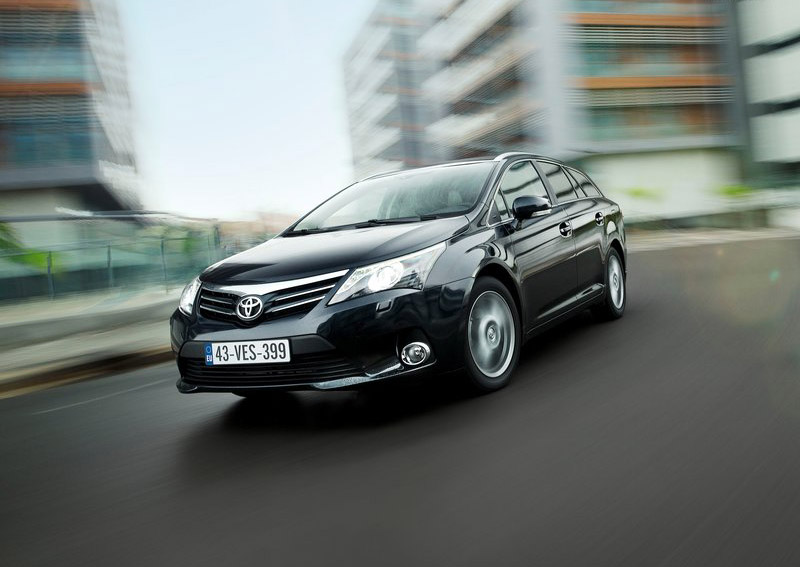
Toyota Avensis, 2012


Toyota Avensis, 2012

The new Toyota Avensis builds on the spaciousness, practicality and fuel efficiency of the current, third generation model.

It features a bolder and more refined exterior design, and interior improvements to finish quality, comfort and Noise, Vibration and Harshness (NVH). Driving dynamics have been enhanced, and a revised grade structure offers even greater value for money. In addition to that Toyota is introducing the Touch and Go Plus, a further advancement of its existing affordable multimedia system.

The best-selling variant of the Toyota Avensis' six engine line-up, the 2.0 D-4D turbodiesel, has been revised to deliver significant improvements in fuel consumption and CO2 emissions. With a tax threshold set at 120 g/km in almost a third of European countries, the 2.0 D-4D's 119 g/km brings generous tax benefits to both private and fleet buyers.

With a choice of two body styles, three diesel and three petrol engines, three transmissions and four model grades, the Toyota Avensis has been specifically tailored to the European market. The D-segment demonstrates a 70% focus on diesel powertrains, a 64% bias in favour of fleet sales and a preference for the wagon body style with over 50% of customers.

EXTERIOR DESIGN ? Elegance and Refinement
Both sedan and wagon versions of the Toyota Avensis are just 15 mm longer than their predecessors, but have been extensively restyled to give them a more elegant and athletic appearance.

The Toyota Avensis represents the first implementation of a new Toyota design language which is based on two key pillars: Under Priority frontal design featuring a trapezoid grille opening, which focuses attention on the lower part of the car for a distinctive, more assertive appearance, and a Keen Look approach for clear, intelligent and expressive styling.

A bolder, more refined frontal treatment features the distinctive new face of the next generation Toyota family. Key to the new Under Priority design direction is a change in the proportions of the upper and lower grilles, with the emphasis now placed on enlarging the latter for a dynamic, more aggressive look.
Beneath a wider and more powerful upper grille design, the lower bumper has been expressively sculpted with a strong, protruding centre section housing a large air intake to give the vehicle a wider stance.

In conjunction with the crisp, Keen Look detailing of integral foglamp pockets placed at the bumper extremities, the design gives the Toyota Avensis a wider, more purposeful stance and a more ground-hugging appearance.

Narrower, more expressive headlamps emphasise the sleek, elegant proportions of the new design. The new headlamps now incorporate Daytime Running Lights, strengthening the Keen Look styling of the new front treatment.
To the rear, the Toyota Avensis sedan features a newly designed rear bumper incorporating a centre guard. A new, sleeker, chromed license garnish design adds a further touch of elegance.

Using LED technology to emphasise the Avensis' Keen Look detailing, both combination lamp clusters and foglamps have been restyled for greater prominence and visibility, reinforcing the wide, stable stance of the new design.

New wheel treatments and an expanded colour range further enhance the Toyota Avensis' exterior design. 16" steel wheels feature a new cap design, whilst the existing 16" and 17" Fuji alloy wheels have been enhanced through new colour and machine facings treatment resulting in a dual-tone colour effect. The other 17" and 18" alloys also benefit from a new, darker colour treatment.

One new exterior colour has been added to the range; the standard Red being replaced by a deep, premium Dark Red which brings added maturity to the new model range.

INTERIOR DESIGN ? Sophistication and Comfort
Within a cabin already praised for its comfort, roominess and practicality, the Toyota Avensis benefits from improved perceived quality across the model range, and upgraded upholstery in a choice of new colours.

The appearance, touch and feel of the entire dashboard have been improved. The centre console layout has been redesigned to improve the switchgear layout and operability. The central air vents have been redesigned and now share the new metal paint finish of the centre console itself, and the side air vents have become chrome trimmed.

The tactile quality and feel of frequently handled parts such as the door trim gripping area, switchgear and the front console all benefit from new, higher quality ornamentation. The driver's instrument dial backlighting has been changed from amber to a higher quality white, and the rear console box lid upholstery has been changed from polyurethane to leather.

The front seatback side support shape has been redesigned for better lateral holding performance, greater comfort and reduced fatigue, and the seat upholstery has been upgraded throughout the model range.

Entry level fabric seat upholstery has been enhanced to offer higher, Sol grade trim quality, Sol grade fabric now features Executive grade trim, Executive grade fabric has been upgraded to a newly introduced Alcantara finish, and Premium grade seats are now finished with high quality perforated leather inserts for improved comfort.

Lightening the overall ambience within the Toyota Avensis' cabin, the leather upholstery is available in a choice of two new colours, Light Grey and Warm Grey in addition to the already existing Black one.

The MULTIMEDIA SYSTEM ? Affordable Touch Screen Interface
The Toyota Avensis benefits from Toyota's unique range of affordable, touch-screen multimedia equipment; Toyota Touch, and the Toyota Touch & Go and Toyota Touch & Go Plus navigation systems.

Toyota Touch
Designed from scratch with all-new hardware and software, Toyota Touch is a 6.1 inch, full colour, touch screen interface which gives centralised control of numerous vehicle functions as well as connectivity to external devices such as mobile phones and portable music players.

Fitted as standard to the Toyota Avensis from Sol grade, Toyota Touch is designed to offer the widest possible range of interactive functions without the added expense of an integral satellite navigation system.

Toyota Touch & Go
Building on the Toyota Touch multimedia base unit and unique to the mainstream market, Toyota Touch & Go offers customers a full map navigation system which represents the best value for money on the market.

Available in 14 languages, Toyota Touch & Go was developed in Europe, with European customers in mind.

Considerably less expensive than traditional multimedia systems, it includes all the most popular navigation functions, such as advanced traffic coverage, and speed and safety camera warnings.
Using a compatible mobile phone, via Bluetooth, Toyota Touch & Go also offers on-board connectivity to Google Local Search -the largest and most up-to-date search database in the world.

Via Google Maps, destinations may be input remotely from home or office, and Points of Interest may be downloaded for entry as destinations.
The installation of Touch & Go also upgrades the multimedia base unit with the addition of an SMS on-screen send and receive function incorporating a contact person image display.

Several Apps are already available to download, including fuel prices, weather and parking space information.
Toyota Touch & Go has been designed specifically to be both affordable and flexible. The system can be easily updated with the newest functions, updated maps and the latest Apps, as they become available.

Toyota Touch & Go Plus
Fitted as standard to Premium grade models and making its world debut in the Toyota Avensis, Touch & Go Plus adds numerous new, advanced technology features to Toyota's remarkable touch-screen multimedia system.
It features advanced voice recognition for navigation address input, one-shot destination entry, music search and play, and phone contact search and call.

It also incorporates email send and receive, a text-to-speech message readout facility, a calendar and, through a Gracenote database, a 'Play More Like This' music function.
Enhanced satellite navigation mapping incorporates 3D city modelling and landmarks. The additional Traffic Patterns database uses the average speed on road depending on time, day and month to optimise your trip.

GRADE STRUCTURE ? Greater Quality and Value for Money
The new Avensis model range will be available in four grade levels - Avensis, Sol, Executive and Premium. Every grade has been revised to deliver greater value for money through improved levels of standard equipment and enhanced sensory quality.

Avensis Grade
The current generation Avensis' generous standard equipment specification is enhanced by the adoption of integral daytime running lights and USB connectivity. Seat upholstery quality has been upgraded by the addition of Sol grade trim, and the sensory quality of the centre console has been improved with a new, silver upper panel and matt black lower panel paint finish.

An expanded options list now features front foglamps, and a Comfort Pack which includes cruise control, a leather steering wheel and a 6-speaker CD stereo system with Bluetooth connectivity.

Sol Grade
To the enhanced Avensis grade specification, Sol grade adds Executive grade quality seat trim, an all-silver centre console paint finish and machine-faced 16" and 17" alloy wheels. The Toyota Touch Display Audio is equipped with a rear parking camera.
Options include the Touch & Go navigation system, rear parking sensors, High Intensity Discharge (HID) headlamps with an Adaptive Front Lighting System (AFS) and a panoramic roof.

Executive Grade
To the improved Sol grade standard specification, Executive grade adds a nickel and wood centre console finish, Alcantara seat trim with leather bolsters, and a new, darker coloured 17" alloy wheel finish.

Amongst the options available are an 11-speaker Display Audio system with rear parking camera, a choice of Touch & Go or Touch & Go Plus navigation systems, High Intensity Discharge (HID) headlamps with an Adaptive Front Lighting System (AFS) on 2.2 litre versions with automatic transmission and a Pre-Crash Safety (PCS) system incorporating Adaptive Cruise Control (ACC), Lane Keep Assist and Lane Departure Warning.

The Premium Grade
Further augmenting the Executive grade specification, Premium grade adds perforated leather upholstery in a choice of Ice Grey, Warm Grey or Black colours. Ice Grey is combined with a bright silver centre console finish, Warm Grey and Black with a warm nickel finish.

High Intensity Discharge (HID) headlamps with an Adaptive Front Lighting System (AFS), a Touch & Go Plus navigation system, an 11-speaker Display Audio system with rear parking camera and new dark finish 18" alloy wheels are all fitted as standard.

DRIVING PERFORMANCE ? Enhanced Driving Dynamics and Improved 2.0 D-4D
Further improvements to ride comfort and driving dynamics were fundamental goals in the development of the Toyota Avensis.

The new Toyota Avensis benefits from increased body rigidity, improved aerodynamics and NVH insulation, greater seat comfort, revised front and rear suspension, and an improved Electric Power Steering (EPS) system. In combination, these engineering enhancements deliver greater ride comfort, improved handling agility, and the promise of a more engaging driving experience.

The best-selling variant of the Avensis' six engine line-up, the 2.0 D-4D turbodiesel, has been revised to deliver significant improvements in fuel consumption and CO2 emissions. This not only lowers the Total Cost of Ownership, but also -with a tax threshold set at 120 g/km in almost a third of European countries and the 2.0 D-4D generating just 119 g/km- brings generous tax benefits to both private and fleet buyers.

Toyota 4Runner, 2010


Toyota 4Runner, 2010

When the first Toyota 4Runner sport utility vehicle (SUV) was launched back in 1984 it was a revolutionary new vehicle based on the mechanics of the four-wheel-drive Toyota pickup truck. The Toyota 4Runner combined the versatility and go-anywhere ability of four-wheel-drive with the comfort and utility found in passenger cars.

25 years, four generations and more than 1.5 million sales later, the Toyota 4Runner continues to evolve while remaining close to its roots. The all-new fifth-generation Toyota 4Runner is even more rugged and athletic, and packed with more power and better mileage. A completely redesigned interior and unique cargo area make the newest Toyota 4Runner smarter, more comfortable, and more versatile than ever.

More rugged than the Toyota Highlander and more versatile than the FJ Cruiser, the 4Runner combines the toughness and durability of body-on-frame construction with multi-use design that excels at a wide variety of tasks.
The newest Toyota 4Runner is taller, wider and longer for 2010, and is available in a variety of configurations. It will be offered in three models, top-of-the-line Limited, a well-equipped SR5, plus a Trail grade for those who require maximum off-road capability.

Drivetrain configurations include rear wheel 4x2, part-time 4x4 and full-time multi-mode 4x4 with a locking center differential. All 4x4 models are equipped with a 4.0-liter V6 mated to a five-speed ECT-i automatic transmission. The 4x2 models will be equipped with either a 2.7-liter four-cylinder engine mated to a four-speed ECT automatic or the 4.0-liter V6 with the five-speed ECT-i automatic. Optional third-row seats allow for up to seven-person capacity.

The Exterior Styling
The design strategy for the new Toyota 4Runner emphasizes a more rugged, powerful stance. Large diameter wheels and tires were added to not only improve off-road performance, but also enhance the Toyota 4Runner's truck-based characteristics. In addition to its styling emphasis on ruggedness and outdoor adventure, the new design utilizes a combination of Toyota's classic boxy form and progressive styling.

All Toyota 4Runner grades feature rugged new bumpers and wider shoulders, with newly designed head- lamp and tail-light systems, which offer a newly-minted, technical design quality and better nighttime performance. The front ends square fender flares meld with a muscular profile that links with a beefy and square rear bumper and back door.

Aluminum alloy wheels are 17-inches in diameter on SR5 and Trail grades and 20-inches on the Limited, and include a full size spare.
In addition to its distinctive front grille, the SR5 grade also adopts overfenders and mud guards to help tackle inclement weather and off-road conditions. A roof rack comes standard for hauling equipment for outdoor activities.

The Trail grade is designed to maximize off-road performance with a superior approach and departure angles, high ground clearance, and an array of functional upgrades for the most demanding active outdoor enthusiast. It can be distinguished by a unique hood scoop, unique 17-inch wheels, black outer mirrors, front and rear bumper guards and dark smoke treatment on the head and tail lamps.

The Limited and SR5 grades add to the muscular design with special touches that provide a premium appearance. The front end includes a chrome-plated front grille insert, fog lamp bezel and front bumper molding. Front and rear overfenders and side skirts are color-keyed. Chrome plating is also found on the side molding, roof rack and rear bumper.

Turn signals on SR5 and Limited V6 grades are now incorporated into the outside mirrors, along with puddle lamps.

Toyota 4Runner is available in six exterior colors. Three new colors, Shoreline Blue Pearl, Magnetic Gray Metallic and Classic Silver Metallic, join carryovers Blizzard Pearl, Salsa Red Pearl and Black.

The New Engine Choices
The 2010 4Runner is powered by a new 4.0-liter V6, which now generates 270 horsepower and 278 lb-ft of torque. Through the use of advanced engine management that includes dual independent Variable Valve Timing with intelligence (VVT-i), the new 4.0-liter engine offers the best of both worlds, adding more power while improving efficiency. For 2010, the new V6 engine produces 34 horsepower more than the prior V6, and 10 horsepower more than the optional V8 of the previous generation.

Additional mileage improvements have come from careful attention to wind flow, reducing aerodynamic drag to a Cd of 0.365. EPA-estimated mileage improves from 16 city and 21 highway to 17 city/23 highway for the 4x2, and from 16 city and 20 highway to 17 city/22 highway for 4x4 models. Both achieve an EPA-estimated 19 mpg combined, an improvement of more than five percent. With the new 4.0-liter engine, maximum towing capacity is 5,000 pounds.

In addition to the upgraded V6 engine, a proven 2.7-liter four-cylinder engine with VVT-i is available on the 4x2 SR5 model. The gutsy DOHC, 16-valve 2.7 makes 157 horsepower and 178 lb-ft of torque. Mated to a four-speed automatic transmission with 2.80:1 first gear and 0.753 overdrive 4th, the 2.7 delivers 18 city/23 highway mpg.

4x4 Capability Designed-In
To build on its tradition of rugged body-on-frame construction, the newest Toyota 4Runner shares the same platform as the FJ Cruiser. Extensive frame and body reinforcements have been added, using high-tensile materials to add strength without adding weight. SR5 and Trail 4x4 models have a two-speed lever-operated, part-time system with neutral position, while the Toyota 4Runner Limited is equipped with full-time, four-wheel-drive with a locking center differential and employs a three-mode, center console-mounted switch. The new Toyota 4Runner is also equipped with a stronger rear differential over the previous model, thanks to a gear ring that has increased in size from 7.87 to 8.18 inches.

To enhance grip, the A-TRAC system is now standard equipment on all 4x4 models. The system can distribute driving force to any one wheel in contact with the ground, making terrain irregularities and slippery patches transparent to the driver. An electronic-locking rear differential is standard on the Trail grade. Axles house 3.73 gears, or 4.56:1 with the 2.7-liter engine and the differential housings have improved seals for better resistance to mud and water.

An array of advanced features, formerly only available in the Land Cruiser, further boosts off-highway capabilities. The Trail grade offers Toyota's Kinetic Dynamic Suspension System (KDSS) as an option. KDSS radically improves terrain-following ability by disconnecting stabilizer bars to allow for more axle travel, and better suspension articulation in slow, difficult terrain.

Toyota's Crawl Control (CRAWL) feature is standard on the Trail grade. CRAWL is an adjustable electro-mechanical system that can be tuned to match the terrain by selecting any of five speed levels. The system maintains an appropriate speed that keeps the vehicle under control and minimizes the load on drivetrain and suspension components. The CRAWL feature helps make traversing difficult terrain easier and safer. With the transfer case shifted into low range, Crawl Control regulates engine speed and output (along with braking force), to propel the vehicle forward or in reverse at one of the five low-speed settings. This allows the driver to maintain focus while steering over very rough level ground or steep grades, without having to also modulate the throttle, or brake, pedals.

The Trail grade also features a Multi-Terrain Select system which allows the 4x4 operator to dial in wheel slip control to match the terrain. In loose terrain such as mud and sand, more-than-normal wheel slip is permitted, allowing wheel-spin to work in the vehicle's favor. On bumpy moguls, or solid rock, wheel slip is minimized and the system acts more like a limited slip. The Mogul setting is for any extremely uneven terrain, such as V-ditches, slopes, and ridges, uphill or down.

All Toyota 4Runner 4x4 models are standard-equipped with Downhill Assist Control (DAC), which is designed to augment the low-speed ascending ability of low-range by holding the vehicle to a target speed with no driver intervention. All V6 Toyota 4Runner models come standard with Hill-start Assist Control (HAC), which provides additional control for off-road driving by helping to keep the vehicle stationary while starting on a steep incline or slippery surface.

On-Road Driving Dynamics
The new Toyota 4Runner may be a truck-based SUV, but it offers the kind of drivability and riding comfort more often associated with car-based platforms.

Coil springs over gas shocks are used at all four corners for a comfortable ride and controlled handling. A double-wishbone independent front suspension, combined with new, variable-flow rack and pinion steering, makes for precise control on demanding roadways. The four-link rear suspension minimizes rear axle hop and assures a smooth ride for back seat passengers.

The Limited grade comes standard with an X-REAS suspension system that further improves performance, comfort and control. X-REAS automatically adjusts the damping force of shocks when driving over bumpy surfaces, or when cornering. The system uses a center control absorber to cross-link shocks on opposite corners of the vehicle, substantially reducing pitch and yaw by offsetting opposing inputs. With X-REAS the new Toyota 4Runner corners flatter, smoother, and handles choppy pavement more easily.

Every Safety Precaution Considered
On-road vehicle dynamics are further enhanced by a suite of high-performance, state-of-the-art safety systems. Standard on 4Runner is Toyota's Star Safety System, which includes Vehicle Stability Control (VSC) with traction control (TRAC), an Anti-Lock Brake System with Electronic Brake-force Distribution (EBD) and Brake Assist. Vehicle Stability Control (VSC) helps to ensure stability by compensating for oversteer or understeer. The system uses selective braking and modulated engine output to keep the vehicle in line with the driver's intended course. On 4x2 vehicles, the Auto LSD (Limited Slip Differential) system allows for better traction on slippery sections of roadway.

The four-wheel ABS with EBD provides the Toyota 4Runner anti-lock stopping control with optimal brake proportioning, whether the vehicle is loaded or unloaded. Hill-start Assist Control (HAC), standard on all 4x4 models and the 4x2 V6, suppresses backward roll when switching from brake to accelerator. All 2010 4Runners have active headrests for driver and passenger, three-point seat belts for all seats, an energy-absorbing body structure and an energy-absorbing hood to help protect pedestrians.

A system of eight standard airbags includes front, side-mounted and knee airbags for the driver and front passenger, and side curtain airbags for the second and third row.

The 2010 4Runner now offers the new Safety Connect telematics system. Available by subscription, with or without the optional navigation system, Safety Connect offers four safety and security features: Automatic Collision Notification, Stolen Vehicle Location, Emergency Assistance Button (SOS), and Roadside Assistance.

In case of either airbag deployment or severe rear-end collision Automatic Collision Notification is designed to automatically call a response center. If a response agent cannot communicate with the occupants, the agent can contact the nearest emergency-services provider to dispatch assistance.

Pushing the in-vehicle "SOS" button allows drivers to reach the response center to request help in an emergency as well as for a wide range of roadside assistance needs. If a Toyota 4Runner equipped with Safety Connect is stolen, after a police report is filed and the driver contacts the response center, agents can work with local authorities to help locate and recover the vehicle.

Safety Connect is standard, factory-installed hardware on the Toyota 4Runner Limited and available via an active subscription. An included one year trial subscription will be offered on equipped new vehicle purchases.
A rear-view monitor system is standard on Limited and Trail grades and optional on the SR5. The system displays in the rear-view mirror, helping to keep track of hard-to-see objects to the rear of the vehicle. A rear clearance sonar system is standard on SR5 models.

Toyota Avalon, 2011


 Toyota Avalon, 2011

The Toyota introduced the boldly redesigned 2011 Toyota Avalon at the 2010 Chicago Auto Show. Evoking a time when travel was sophisticated, elegant and comfortable, the new Toyota Avalon possesses a distinctive new exterior style while offering a restyled interior rich with premium touch points and practical new technologies.
Even with numerous refinements inside and out, the Toyota Avalon remains true to the idea that comfort is honest and uncomplicated, and "Traveling Avalon Class" is rich in simple, familiar pleasures.

The new Toyota Avalon has dynamic and expressive lines, and an infusion of comfort, safety and technology advancements that enrich the driving experience. Upgraded equipment and technology features, such as a touch-screen navigation system with real-time traffic, and Bluetooth® hands-free phone capability with music streaming to the audio system are among the improvements that enhance the 2011 Avalon's excellent blend of spaciousness, comfort and technology.
Restyled at Calty Design Research in Newport Beach, Calif., the Toyota Avalon is assembled at Toyota Motor Manufacturing Kentucky (TMMK), a "zero landfill" facility that also assembles the Camry, Camry Hybrid, and Venza. It was also developed at the Toyota Technical Center (TTC) in Ann Arbor, Mich.

Dynamic New Exterior
For 2011, Calty restyled Toyota Avalon to project an elegant, outgoing presence. A wider, more substantial grille ties into state-of-the-art projector headlamps, working with a broad, undisturbed front hood to suggest a lowered center of gravity and emphasize the Toyota Avalon's wide stance.

The new headlamps, which combine multi-reflector halogen high beams with halogen or HID low beams, utilize light pipes to create a signature, night-time appearance. The front fog lamps, now integrated into a trapezoidal front bumper, provide a wider angle of illumination.
Viewed from the side, the 2011 Avalon is enhanced by additional use of chrome trim, redesigned rocker panels, and glare-resistant outer mirrors with integrated turn signals. New 17-inch wheels on the Limited grade feature a 10-spoke design with a mirror finish.

At the rear of the car, identification is cleanly defined by a single Avalon logo located above the license plate. Dual-exhaust pipes are integrated into the cutaway trapezoid shape of the lower bumper for a modern image. Taillights have been reshaped to reduce turbulence at the rear, helping to create a lower coefficient of drag. The new lights integrate stop, turn and side marker lighting functions in one combined lamp. Unique LED light pipes with dark aluminized sides and both clear and red lenses project a modern appearance.

The Spacious Interior Built For Comfort
For 2011, a new interior has been designed with a contemporary style. The new interior remains generously spacious and elegant, fitted with comfortable seating and thoughtfully integrated amenities. Coordinated colors and rich wood-grain materials were carefully chosen to convey an optimistic attitude and modern essence.

Standard leather-trimmed front seats and seatbacks on the Limited are fitted with ventilation systems and an enlarged perforation area to help keep them cool. Interior seats feature thicker stitching, which provides an elegant accent to the interior design. Active front headrests are also standard.
The rear seating area is configured to seat three passengers comfortably, with ample legroom and reclining rear seats, unique in the segment. The rear headrests have also been reshaped and enlarged for better support, and a convenient flip-down center armrest provides storage when the middle seat is not in use.

A power rear sunshade, deployable via a one-touch lever, filters direct sunlight coming through the rear window. The sunshade, which helps to protect rear seat passengers from unwanted light and heat, automatically detracts when the driver selects reverse gear.
A new instrument panel incorporates visually attractive and highly readable Optitron gauges that use graduated white illumination with white pointers. They are set inside smoked lenses and deep chrome rings that add depth and a sense of luxury.
The steering wheel includes controls for Bluetooth hands-free phones, the audio system, climate system, and the information center.

The Technology-Enriched Environment
A comprehensive infusion of technology was designed into the new interior to ensure an enriched environment, with enhanced function and connectivity.
New standard equipment includes Bluetooth® hands-free phone and music streaming to the audio system from a compatible device, XM® satellite radio (subscription required), and both USB and 1/8-inch auxiliary connections for iPod® and other audio devices. Each of the three available audio systems can control iPods seamlessly using switches located on the steering wheel and display track information stored in the device.

The Toyota's latest DVD Navigation system has a newly adopted database and now has easier search and address input functionality. The Navigation system also offers new displays for road icons and points of interest, and a keyboard screen arranged in the same way as a personal computer.

The Toyota Avalon grade's standard nine-speaker system offers exceptional sound quality, while the Limited grade features a standard 12-speaker, 660-watt JBL Premium Synthesis audio system with enhanced two-coil sub-woofer. The system uses 12 speakers and a 12-channel digital amplifier to deliver profoundly rich, full sound to all seats of the vehicle.
A rear-view monitor function is standard in the rear-view mirror or with the navigation system. The rear-view-mirror image includes on-screen back-up guides that help drivers to back into parking spots or driveways.

The Performance and Efficiency Combined
Toyota Avalon's exceptional combination of ample horsepower and excellent fuel economy offers one of the best overall dynamic performances in the large sedan segment.
The 2011 Avalon is powered by a 24-valve, dual-overhead cam 3.5-liter V6 engine that produces 268 horsepower at 6,200 rpm. The engine is equipped with the latest dual VVT-i electronic valve-control mechanism that provides a broader powerband, while requiring less fuel and generating fewer emissions. It is mated to a multi-mode six-speed automatic transmission.

The 2011 Toyota Avalon is an Ultra Low Emission Vehicle (ULEV), EPA-estimated to deliver 20 mpg in the city, 29 highway, and 23 combined, as good as or better than any V6 model in the segment.
A roadworthy mix of fine ride quality and accurate driving control is delivered by the Toyota Avalon's MacPherson strut suspension, which uses coil springs at all four corners. Rack-and-pinion steering combines with front-wheel-drive and optimized steering gear for a natural handling feel.

The Simple Comforts Throughout
A dual-zone climate control system has nine air-flow modes for more precise control of interior climate, and a clean-air filter removes dust and pollen. Doors use three stop positions instead of two for easier entrance and exit. A lockable glove box has a pneumatic-door damper and inner box illumination. The front-console box has a sliding armrest that moves 4.7 inches front to rear, able to accommodate a wide range of driver positions. The elegantly stitched top is padded with a double density cushion material for softness. Inside, there is a 12-volt outlet in addition to the USB and auxiliary audio terminals.

Safety is Standard
The new Toyota Avalon's occupant-safety strategy includes use of extensively tested energy absorbing structures, protective side impact beams and overhead structure, advanced belt systems and active front headrests as standard equipment. Toyota Avalon will also have a redesigned accelerator pedal assembly and a brake override system.

Seven airbags, including a front knee bag for the driver, and front side curtain airbags for both rows, are also standard. Toyota's standard Star Safety System includes Vehicle Stability Control (VSC), anti-lock braking system (ABS) with Electronic Brake force Distribution (EBD), Brake Assist, and TRAC traction control system. TRAC and VSC functions can be disengaged if the driver needs to free the vehicle if stuck in mud or snow.

A full-size spare and alloy wheel is standard. Each wheel has its own pressure sensor to warn if tire pressure drops, providing the driver with an early warning to find a safe place to change a tire.

Simplified Packaging
The 2011 Toyota Avalon will be available in two grades when it arrives in showrooms in the spring of 2010, Avalon and Limited. Both grades will be well equipped with standard equipment like eight-way leather-trimmed power driver's seats, back-up camera, dual zone automatic climate control with air filtration, moonroof and 17-inch alloy wheels. Limited will have additional standard equipment, such as an eight-way passenger's seat with lumbar support, driver's seat cushion extension, rain-sensing wipers, Smart Key and cooled leather seats. Toyota Avalon grade can be upgraded with features like a JBL Synthesis sound system and heated front seats, while Navigation is optional for both grades.

Color and Trim
Toyota Avalon will be available in nine exterior colors including three new colors: Zephyr Blue Metallic, Cypress Pearl and Sizzling Crimson Mica. Additional colors include Cocoa Bean Metallic, Blizzard Pearl, Classic Silver Metallic, Magnetic Gray Metallic, Black, and Sandy Beach Metallic. Toyota Avalon grade will be mated to three leather-trimmed interior colors: Ivory, Light Gray, and Black. Limited grade receives Ivory, Light Gray, and Black Bordeaux trims with accent-color trim on the vertical surfaces.

Wednesday, June 16, 2010

Toyota FT-86 Concept, 2009

Toyota FT-86 Concept, 2009


The Toyota FT-86 Concept is 4,160mm long, 1,760mm wide, and 1,260mm high with a wheelbase of 2,570mm, giving it a compact feeling that is easy for the driver to handle while able to accommodate four occupants. In addition to being light and having a low center of gravity, the Toyota FT-86 Concept boasts the handling of a racing car as well as a 6-speed manual transmission and ADVICS brakes.

The stylish concept captures the heart with the "functional utility" of its highly-refined body. It is the creation of Toyota Europe Design Development known as ED2, which has established body lines that take into consideration a low center of gravity and aerodynamics. The interior is distinctive, featuring an instrument panel with a gray and white base, gauges with red neon lights and digital displays, and a navigation system. In addition, a zipper that evokes an image of interior lapping with minimal covering of a highly-refined body presents a striking display.

The Toyota FT-86 Concept is neither an electric vehicle nor a hybrid vehicle, but is a sports model with a gasoline engine developed to convey the essential appeal of automobiles in a new era. It is a must-see concept car that expresses TMC's desire to once again create a Toyota sports car.

The Small FR Sports Concept Vehicle that Combines Environmental Performance and the Joy of Driving

TMC seeks to develop the ultimate earth-conscious environmentally-considerate vehicle with a focus on hybrid technologies without losing sight of the appeal of cars themselves or the joy of driving.

Over the past several years, the need has been rising for motor vehicles that take into consideration global warming and other environmental issues, while there has also been concern that there have been too few new sports cars that make the heart beat faster and that the time is right for a new generation of sports cars. In response to these needs, TMC has developed the Toyota FT-86 Concept, a sports car equipped with a 2,000cc, horizontally opposed, four-cylinder, naturally-aspirated gasoline engine that evokes the joy of driving a car and the pleasure of vehicle ownership.

Related Posts Plugin for WordPress, Blogger...