Showing posts with label Hyundai. Show all posts

Thursday, June 13, 2013

Hyundai Elantra GT, 2013


  •  Hyundai Elantra GT, 2013

The Hyundai Motor America introduced the all-new 2013 Elantra GT in a North American debut at the 2012 Chicago Auto Show. Hyundai Elantra GT brings five-door functionality and European driving dynamics to the expanding Elantra lineup and is slated to hit dealerships in summer 2012. The lineup now includes Elantra Coupe and the popular Elantra sedan, the 2012 North American Car of the Year. Hyundai Elantra GT is based on the new-generation i30 model designed for the European market.

The 2013 Elantra GT compete with the Ford Focus, Mazda3 and Volkswagen Golf, featuring more interior volume than these models, unsurpassed fuel economy and Hyundai's Driver Selectable Steering Mode.

Hyundai Elantra GT is the third vehicle in Hyundai's 7/11 product initiative (seven new or redesigned models in the next 11 months). The first two vehicles in the initiative were the Veloster Turbo and refreshed Genesis Coupe. The fourth vehicle is the Elantra Coupe.

FURTHER EVOLUTION OF 'FLUIDIC SCULPTURE' DESIGN
The Hyundai Elantra GT represents further evolution of the Hyundai form language, 'Fluidic Sculpture' - the company's distinctive design DNA. The 'Fluidic' essence provides the Elantra GT with a slippery .30 coefficient of drag. Everything about Hyundai Elantra GT is aerodynamic from the aggressive profile and low overall height, to the sleek side mirrors. Tire gaps are minimized while rocker panels are streamlined. Lower wind resistance translates into better fuel economy and a smoother ride.

Up front, Hyundai's signature hexagonal grille with chrome accents flows into the hood. The bodyside graphic features a chrome beltline molding to keep up with the sleek character lines. Sharp projection headlamps, fog lights and available 17-inch alloy wheels with chrome spears complete the modern design.

BEST-IN-CLASS STANDARD FUEL ECONOMY
Hyundai Elantra GT's standard fuel economy is an estimated 28 mpg city, 39 mpg highway and 32 combined with the six-speed automatic transmission or manual transmission. These figures give Elantra GT a highway-only driving range of more than 500 miles and combined city/highway driving range of up to 448 miles.

LIGHTEST FIVE-DOOR HATCHBACK IN THE COMPACT SEGMENT
Hyundai Elantra GT's widespread use of high-strength steel provides a 37 percent increase in body stiffness at a lower body weight when compared to the outgoing Elantra Touring model. High-strength steel allows the suspension to work optimally. At 2,784 pounds, the automatic transmission Elantra GT is lighter than its competitors, while offering more interior room than Focus, Mazda3, Golf and Matrix. Elantra GT is the lightest five-door hatchback in the compact segment. It is 175 pounds lighter than Focus, 151 pounds lighter than Mazda3 and 222 pounds lighter than Golf. This weight-efficient unibody architecture allows for Elantra to achieve an estimated 39 mpg EPA highway rating, without the need for a special eco model. Hyundai Elantra GT's best-in-class fuel efficiency is driven by the Blue Drive strategy. A key to Elantra GT's extensive use of high-strength steel is an $8 billion dollar investment Hyundai made to become the only global automaker with its own fully integrated steel plant. Hyundai has 400 metallurgists focused on the task of developing optimized steel recipes for every part and panel in new vehicle architectures.

MODERN POWERTRAIN
Under the hood, Hyundai Elantra GT is powered by a 1.8-liter Nu four-cylinder engine with 148 horsepower and 131 lb-ft of torque (145 horsepower and 130 lb-ft of torque for Elantra PZEV). Thanks to advanced clean engine technology, most Elantra GTs sold in California, Oregon and several Northeast states are certified as Partial Zero Emission Vehicles (PZEV) by the EPA. The PZEV Elantra GT is as clean as many hybrid electric vehicles, helping Hyundai meet its environmental commitments. Elantra is also available as an Ultra Low Emission Vehicle (ULEV). Additionally, Hyundai Elantra GT has an ActiveECO System that modifies engine and transmission control to smooth out throttle response and increase real-world fuel economy by up to seven percent.

The Nu engine features an aluminum cylinder head, crank and block with a cast iron cylinder liner. The 1.8-liter Nu also offers Dual Continuously Variable Valve Timing (D-CVVT) camshafts and hydraulic engine mounts for optimum power, efficiency and refinement. Using CVVT on both camshafts has several advantages when compared with using it just on the intake camshaft. With D-CVVT, there is a two percent improvement in performance (increased volumetric efficiency), two percent improvement in fuel economy (reduced pumping loss) and a 30 percent reduction in hydrocarbon emissions. In the valvetrain, roller swing arms and hydraulic lash adjusters reduce valve driven friction to improve fuel economy by one percent, compared with direct valve driving. The Nu engine also features a maintenance-free silent timing chain system to enhance durability and improve Noise Vibration and Harshness (NVH).

The application of a composite resin two-stage Variable Intake System (VIS) versus aluminum, enables switching between long and short intake manifolds, resulting in a four percent improvement in performance, a 15 percent reduction in cost and a 30 percent reduction in weight.

Another tool Hyundai engineers have incorporated into Elantra GT is an electronic throttle control. The electronic throttle control replaces the conventional cable and mechanical linkage with fast responding electronics. This system accurately controls air intake and engine torque, improving drivability, response and fuel economy.

The Nu four-cylinder engine also has an offset crankshaft design that reduces friction between the piston and cylinder wall for a one percent improvement in fuel economy.

SIX-SPEED TRANSMISSIONS
The 2013 Elantra GT can be equipped with a six-speed manual (M6CF3-1) or automatic (A6GF1) transaxle with SHIFTRONIC® manual control. Hyundai Elantra GT's six-speed manual transmission provides short, crisp shifts and further optimizes engine performance. These crisp shifts are courtesy of triple-cone synchronizers for first and second gears, double-cone for third gear and single-cone for fourth, fifth and sixth gears.

INTERIOR SPACE AND PRACTICALITY
Maximizing interior volume and delighting customers with various seating layouts are hallmarks of Hyundai engineering and translate into more cabin room, cargo space and versatility. The Elantra GT features seating layouts that can comfortably seat five people or accommodate four passengers, plus long items like golf clubs or snowboards. Fold down two seats, to seat three people and hold larger packages or fold all of the back seats to get CUV-sized cargo space. These options allow customers to discover that Elantra GT has more interior volume than Matrix, Mazda3, Ford Focus and VW Golf and even more cargo capacity than the Nissan Juke crossover, thanks to fold-flat rear seats and rear seat cushions than can flipped upward.

The Hyundai Elantra GT includes a number of convenient, standard stowage and storage features, including a sunglasses holder, two front and two rear cupholders, door bottle holders, cooled glove compartment, central console storage, sliding armrest, front storage tray, front seatback pockets and a cargo area under-floor storage. The cargo area also has a 12-volt outlet for consumers who desire an outlet to plug in their portable electronic devices.

ELANTRA GT ARCHITECTURE
Elantra GT is fitted with a MacPherson strut front suspension, with coil springs and gas shock absorbers. The rear suspension is comprised of a light weight coupled torsion beam for enhanced steering stability and monotube shock absorbers. A 22 mm diameter front stabilizer bar helps reduce body roll when cornering. Hyundai Elantra GT is tuned for added feel, responsiveness and control, while the Elantra sedan is tuned for comfort. Modifications to the GT include higher rear spring rates, a stiffer twist beam and Sachs dampers for improved body motion control. These changes create driving dynamics which are sporty and comfortable. In addition, two suspension packages were developed to optimize tuning for the two different tire sizes. The Elantra GT's Style package offers a sportier suspension calibration that is optimized for its lower-profile P215/45R17 tire.

Behind the wheel, drivers benefit from Hyundai's all-new Driver Selectable Steering Mode. With three operating modes to select - Comfort, Normal and Sport - this innovative system allows drivers to adapt Hyundai Elantra GT steering characteristics to varying driving preferences and road conditions any time they choose. Comfort level offers the greatest ease of steering and is ideal for city and parking environments. Sport is optimized for higher-speed highways or winding roads, while Normal is ideal for a mix of driving conditions. The Driver Selectable Steering Mode not only adjusts power assistance levels in each mode, but also on-center build-up feel and steering build-up curves throughout the steering range, for a very natural, progressive feel. Steering damping characteristics, active return gain, and high frequency friction levels have also been optimized for Elantra GT in this system. Even more, Elantra GT's turning diameter of 34.8 feet is better than Matrix, Focus and Golf.

OVERALL DIMENSIONS
The all-new Hyundai Elantra GT rides on a 104.3-inch wheelbase and has an overall length of 169.3 inches. The height is 57.9 inches and the width is 70.1 inches.

CABIN REFINEMENT
Cabin refinements on the all-new Elantra GT are inspired by the high standards of the entire Hyundai lineup. Located in the center console, the available navigation system is displayed via a seven-inch touch-screen and incorporates the rearview camera screen. Elantra GT's rearview camera is like no other. This mechanized camera is hidden behind the Hyundai flying H badge on the rear hatch and only appears when needed.

Dual-zone climate controls ensure a comfortable environment for all occupants during long journeys, and the addition of a panoramic sunroof provides increased natural light within the cabin. The Dual-zone climate controls also incorporate an automatic defogging system, which detects humidity levels using a sensor and removes it from the windshield. Another premium feature in the Hyundai Elantra GT is a CleanAir Ionizer that automatically cleans the air when the heater or air conditioner is running.

Elantra GT comes standard with a 172-watt AM/FM/Satellite Radio/CD/MP3 audio system with six-speakers and iPod®/USB/auxiliary input jacks. A Bluetooth interface is also standard. The sound system plays compact discs, accesses digital music files via Bluetooth streaming audio or allows driver and passenger to access their personal listening devices through the iPod/USB/auxiliary inputs. The SiriusXM Satellite Radio interface is also integrated into the navigation unit and features channel logos, real-time NavTraffic and Data services, such as NavWeather®, Stock Ticker and Sports Ticker. Users can even upload personal pictures from a USB rather than a CD to be displayed on the system's home screen.

Elantra GT offers many premium features:
    Standard cooled glove box
    Standard heated front seats
    10-way power driver's seat including power lumbar support
    Clean Air Ionizer
    Leather seating surfaces
    Automatic headlights
    Side mirrors with integrated turn signal indicators
    Standard steering-wheel-mounted audio and cruise controls
    Standard Bluetooth hands-free system with voice recognition

HYUNDAI BLUE LINK
Hyundai Blue Link is standard on the 2013 Elantra GT. "Blue Link combines safety, service and infotainment into a complete package that works to both help simplify Hyundai owners' lives and reduce distracted driving," said Barry Ratzlaff, director of customer satisfaction and service business development, Hyundai Motor America. "We've carefully studied how drivers rely on smart phones and navigation systems as an innovative link to the outside world. Blue Link brings that seamless connectivity directly into the car with technology like voice-to-text messaging, POI web search download, turn-by-turn navigation, and monthly vehicle reporting. Our agent-assisted advanced voice recognition system offers a 21st century solution to performing POI searches in the vehicle. This unique and innovative approach enables Hyundai to deliver fast, accurate searches and downloads of POIs to vehicles without traditional operator-only type systems of our competitors."

Blue Link-equipped vehicles include core safety services for an introductory period. These key safety services include: Automatic Crash Notification (ACN) and Assistance, SOS Emergency Assistance, and Enhanced Roadside Assistance. After the introductory period, owners of Blue Link-equipped vehicles can choose to extend these and other services as desired.

Blue Link Assurance further expands Hyundai's industry leadership formerly established by Hyundai Assurance, the industry's most comprehensive suite of new-vehicle protection.

SAFETY FEATURES
The all-new Hyundai Elantra GT features the latest active and passive safety technologies to ensure maximum protection for its occupants. Active safety features include ESC (Electronic Stability Control), ABS (anti-lock braking system) with Electronic Brake-force Distribution and Brake Assist and VSM (Vehicle Stability Management). In terms of passive safety, the Elantra GT will be fitted with seven airbags as standard - front, side and curtain including an Elantra-first driver's knee airbag.

Friday, April 12, 2013

Hyundai Elantra Coupe, 2013


  • Hyundai Elantra Coupe, 2013

Hyundai introduced the Elantra Coupe variant to its industry-leading Elantra line-up at the 2012 Chicago Auto Show. This two-door coupe model of the Elantra sedan, available this spring, will attract even more buyers to the Elantra line-up, further expanding its appeal to savvy consumers. It offers many of the same attributes that made the sedan version a sales success, while broadening its market reach to youthful, sporty buyers willing to forgo four-door versatility for coupe design appeal. The 2013 Hyundai Elantra Coupe marks the continuing evolution of Hyundai's "Fluidic Sculpture" design theme with sporty design language, while assuming a compact coupe segment leadership position with an eco-efficient powertrain, generous convenience features, exceptional roominess and abundant safety features.

The Hyundai Elantra Coupe is the latest vehicle in Hyundai's 7/11 product initiative (seven new models in the next eleven months), following the Azera and Genesis Coupe.

The 2013 Elantra Coupe represents a modern approach to the sporty coupe segment, using youth-oriented design and premium features offered with Hyundai's strong value proposition. The 2013 Hyundai Elantra Coupe poses intriguing questions:
  •     Why can't a sporty coupe combine generous interior space with sleek design?
  •     Why pay premium coupe prices to get advanced safety and technology features?
  •     Why can't a fun-to-drive sporty coupe offer 40-mpg fuel economy?

"FLUIDIC SCULPTURE" DESIGN LANGUAGE

Elantra Coupe takes Hyundai's dynamic "Fluidic Sculpture" design principles to the next level. "Fluidic Sculpture" design language replicates the interaction of wind with rigid surfaces to create a perception of fluid in motion.

Hyundai's signature hexagonal front fascia opening and jeweled swept-back headlights give Elantra Coupe a lean, aggressive demeanor. Fog lights and available side mirror repeater lamps complement the view from the front.

From the side, Hyundai Elantra Coupe conveys a wedge-like sport coupe silhouette with deeply sculpted surfaces. SE model sporty five-spoke 17-inch alloy wheels with dark spoke inserts add a dynamic presence, while fast A- and C-pillar angles frame a sharply tapered greenhouse, further accentuating the wedge profile. Just below the belt line, a prominent character line carries from the door through to the rear deck. Wheel arch creases give a subtle flared appearance around front and rear wheels, for a wide and aggressive presence. Further, a beveled rocker panel rounds out the lean and muscular effect.

From the rear, a blacked-out rear diffuser valance contrasts with dual chrome-tipped exhaust tips, and the SE model deck lid incorporates a lip spoiler design element.

These sculpted surfaces serve to create a highly aerodynamic body. The drag coefficient for the Hyundai Elantra Coupe is an exceptionally low 0.28 Cd, resulting in minimal cabin noise intrusion and optimal fuel economy. Elantra Coupe was designed at Hyundai's North American Design Center in Irvine, Calif.

40-MPG POWERTRAIN
Under the hood, the Hyundai Elantra Coupe is powered by the same 1.8-liter Nu four-cylinder engine with 148 horsepower (estimated) and 131 lb-ft of torque (estimated) found in the Elantra sedan (145 horsepower and 130 lb-ft of torque for Elantra Coupe PZEV). This high power-density 4-cylinder puts out a full six percent more horsepower than the Civic Coupe 1.8-liter. Thanks to advanced clean engine technology, most Elantra Coupes sold in California, Oregon and several Northeast states are certified as Partial Zero Emission Vehicles (PZEV) by the EPA. The PZEV Elantra Coupe is as clean as many hybrid electric vehicles, without the extra technological complexity and cost. The PZEV Elantra Coupe helps Hyundai meet and exceed its environmental requirements. Outside of these "green" states, the Hyundai Elantra Coupe is available as an Ultra Low Emission Vehicle (ULEV).

The Nu engine features an aluminum block with a cast-iron cylinder liner, cylinder head and crank. This unique configuration results in a block that is 30 percent lighter than an iron block, shedding more than 74 pounds of engine mass, while still providing equivalent strength.

The 1.8-liter Nu also offers Dual Continuously Variable Valve Timing (D-CVVT) camshafts and hydraulic engine mounts for optimum power, efficiency and refinement. Using D-CVVT on both camshafts has several advantages when compared with using it just on the intake camshaft. These advantages include a two-percent improvement in performance (via increased volumetric efficiency), two-percent improvement in fuel economy (via reduced pumping losses) and a 30 percent reduction in hydrocarbon emissions. In the valvetrain, roller swing arms and hydraulic lash adjusters reduce valve-driven friction to improve fuel economy one percent compared with direct valve tappets. The Nu engine also features a maintenance-free silent timing chain to enhance durability and reduce noise, vibration and harshness (NVH).

A plastic two-stage Variable Intake System (VIS) enables intake air to be directed between long and short intake manifolds, resulting in a broad, linear power band. This results in a four-percent improvement in performance, a 15 percent reduction in cost and 30 percent reduction in weight, when compared with aluminum.

Another technology Hyundai engineers have incorporated into the Hyundai Elantra Coupe is an electronic throttle control. Electronic throttle control replaces the conventional cable and mechanical linkage with instantaneous computerized control. This system accurately controls air intake and engine torque, improving drivability, response and fuel economy.

To further improve fuel economy, Elantra Coupe applies double-pipe plumbing technology to the internal heat exchanger. Double-pipe plumbing improves cabin cooling efficiency, while minimizing compressor size, reducing fuel consumption. In addition, an externally-controlled variable compressor is used to improve fuel efficiency when compared with an internal variable compressor.

The Nu four-cylinder engine also has an offset crankshaft design that reduces friction and pressure between the piston and cylinder wall for a one-percent improvement in fuel economy.

Hyundai Elantra Coupe's fuel economy is estimated at 29 mpg city, 40 mpg highway for the six-speed manual transmission, and 28 mpg city, 39 mpg highway for the six-speed automatic transmission. These ratings give Elantra Coupe a highway-only driving range of up to 500 miles.

SIX-SPEED TRANSMISSIONS
The Hyundai Elantra Coupe can be equipped with a six-speed manual (M6CF3-1) or automatic (A6GF1) transaxle with SHIFTRONIC® manual control. Hyundai now has in-house six-speed automatic transmissions in its small, medium and large FWD cars. Hyundai is also only one of four global car manufacturers building in-house unique six-speed automatic transmissions.

The six-speed automatic is 11 pounds lighter than Hyundai's global five-speed. It is considerably simpler, having 62 fewer parts, for greater durability, lighter weight and lower cost. It also features an ultra-flat torque converter that shortens the unit's overall length by 0.43 inches, while being 2.6 pounds lighter.

This transmission, mated to the 1.8-liter Nu engine, helps Elantra Coupe deliver improved fuel efficiency - 11 percent more than its closest competitor, the Honda Civic Coupe.

The Hyundai Elantra Coupe's six-speed manual transmission offers positive shift feel and further optimizes powertrain performance. Shifting performance is facilitated by durable triple-cone synchronizers for first and second gears, with double-cones for third gear and a single-cone for fourth, fifth and sixth gears.

OVERALL DIMENSIONS
The Elantra Coupe rides on a 106.3-inch wheelbase, an overall length of 178.7 inches, 69.9-inch width, and 56.5 inch height for uncompromised headroom. Elantra's total interior volume of 110.2 cubic feet exceeds the 2012 Honda Civic Coupe and 2012 Kia Forte Koup by large margins. The Coupe's long wheelbase allows for compact coupe efficiency with class-above relative comfort levels. Hyundai Elantra Coupe's trunk volume at 14.8 cubic feet also beats Civic Coupe and Kia Forte.

ELANTRA COUPE ARCHITECTURE
The Elantra Coupe is fitted with a McPherson strut front suspension, with coil springs and gas shock absorbers. The rear suspension is a lightweight coupled torsion beam rear design for enhanced steering stability and monotube shock absorbers for ride comfort and control. A substantial 22.0-mm diameter front stabilizer bar helps reduce body roll and turn-in response when cornering. Steering knuckle design, torsion beam rigidity and damper tuning have all been recalibrated for sportier handling and steering responsiveness compared with Elantra sedan. In addition, Hyundai Elantra Coupe offers a sportier SE model suspension calibration that is optimized for its lower-profile P215/45R17 tire.

All Elantra Coupes have column-mounted, motor-driven electric power steering (MDPS) that adjusts instantly to changing driving conditions while improving fuel economy over a hydraulic steering system. A quick-ratio steering rack is used for crisp feel on turn-in.

World-class weight efficiency was a key program target for the Elantra Coupe engineering team. As a result, Hyundai Elantra Coupe leads the Kia Koup in weight efficiency, while leading the Civic Coupe in power-to-weight ratio; both are key measures of overall powertrain and structural efficiency.

High-strength steel in Elantra Coupe's structure allows the suspension to work with precision in all driving conditions. This weight-efficient unibody architecture allows for Elantra Coupe to achieve an estimated 40-mpg EPA highway rating, without the need for a special eco model and its incremental costs.

SPORTY, SOPHISTICATED INTERIOR
Inside the Hyundai Elantra Coupe, customers will find Hyundai's expertise in interior packaging, lighting, leading-edge design and craftsmanship. This approach is visible in gauge clarity and the tilt and telescopic steering wheel. Seat construction uses lightweight materials and environmentally-friendly foam for further benefits to fuel efficiency. Elantra Coupe seat design also provides deeper side bolsters compared with Elantra sedan for sportier driving. Heated seats are standard equipment on all Elantra Coupes, while the SE model offers sporty aluminum pedals.

The Hyundai Elantra Coupe offers two interior color choices, gray and black, available with either the GS or SE trim. All Elantra Coupes have cloth-like pillar trim made of fibrous tissue and volcanic rock for a premium look, feel and minimal environmental impact. Elantra Coupe will offer seven exterior colors, three of which are unique from Elantra sedan color choices: Monaco White Black Noir Pearl and Volcanic Red.

Hyundai Elantra Coupe is available with two audio systems. Standard is a 172-watt AM/FM/Satellite Radio/CD/MP3 audio system with six-speakers and iPod®/USB/auxiliary input jacks. A 360-watt system with external amplifier is optional with the SE Technology package.

Touch-screen navigation is available on SE trim and includes a high-resolution 7.0-inch screen and voice-activation by headliner-mounted microphone. The sound system plays compact discs, accesses digital music files via Bluetooth streaming audio or allows driver and passenger to access their personal listening devices through the iPod/USB/auxiliary inputs. Bluetooth audio wirelessly streams music from select mobile phones to the head unit. The XM Satellite Radio interface is also integrated into the navigation unit and features channel logos, real-time NavTraffic and XM Data services, such as XM NavWeather®, XM Stock Ticker and XM Sports Ticker. The system also integrates a rear-view camera, which cannot be found on the Honda Civic Coupe or Kia Koup. Users can even upload personal pictures from a USB rather than a CD to be displayed on the system's home screen.

The Elantra Coupe owners can also get premium features, such as proximity key with push-button start, leather seating surfaces, heated front seats, power sunroof, and dual automatic temperature control with Clean Air Ionizer and auto-defogger.

ADVANCED STANDARD SAFETY TECHNOLOGIES: PART OF HYUNDAi'S ASSURANCE COMMITMENT

The Hyundai Elantra Coupe takes compact coupe safety to the next level with the introduction of Vehicle Stability Management (VSM). Similar to the one found in the Hyundai Equus, VSM optimally manages ESC (Electronic Stability Control) and the Motor-Driven electric Power Steering (MDPS).

VSM works to control two effects. The first is when a driver accelerates or brakes on a split-mu surface (slippery on one side, dry pavement on the other) and the vehicle wants to pull in one direction. VSM detects this condition and sends a signal to the MDPS to apply steering assist. VSM counters the pull and automatically provides eight Newton meters of counter steering force. VSM reacts the same way during sudden lane changes or fast cornering. ESC is still not standard on the Civic Coupe.

Elantra Coupe features six airbags—including dual front, front seat-mounted side-impact, and front and rear side curtain airbag.

The Elantra Coupe also features a state-of-the-art braking package. The package includes four-wheel disc brakes and an Anti-Lock Braking System (ABS) including Brake Assist, which provides maximum braking force when a panic stop is detected, and Electronic Brake-force Distribution (EBD), to automatically adjust the braking force to front and rear axles based on vehicle loading conditions and driving dynamics. Hyundai Elantra Coupe engineers even looked at something as simple as the parking brake for an integrated rear parking brake caliper for weight reduction.

In terms of passive safety, the Hyundai Elantra Coupe has strong unibody construction, along with front and rear crumple zones to effectively absorb and dissipate impact energy away from cabin occupants.

Monday, April 16, 2012

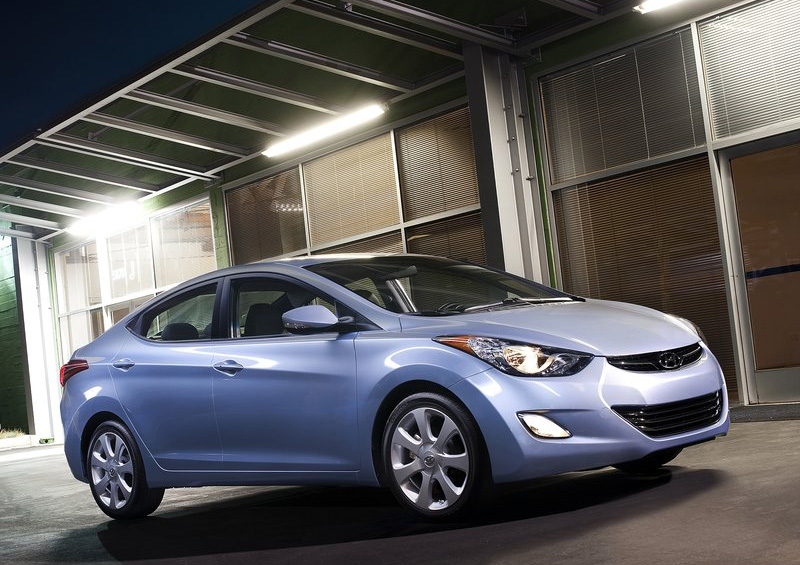
Hyundai Elantra, 2011


Hyundai Elantra, 2011

Elantra exemplifies Hyundai's emotional "Fluidic Sculpture" design principles. "Fluidic Sculpture" considers the interplay of wind with rigid surfaces to create the illusion of constant motion. Hyundai Elantra is an evolution of the design qualities found in Sonata.

Successful sedans in the U.S. market all have a distinct silhouette and Day Light Opening (DLO - a designer's term for the side glass) and Hyundai Elantra is no different. Along Elantra's sides are Sonata's flowing lines, with the addition of a strong undercut feature line starting at the front door. These lines, along with muscular wheel arches and a sleek roofline, create a memorable and spacious package. Flowing lines also lead to an aerodynamic body. The drag coefficient for the Hyundai Elantra is an exceptionally low 0.28 that compares favorably to the Chevrolet Volt (0.29).

Hyundai's signature hexagonal front grille and detailed swept-back headlights give Hyundai Elantra a compact athletic face. The assertive stance is complimented by 15-, 16- or 17-inch alloy wheels and athletic proportions. Available fog lights and side repeater mirrors complete the distinct design. Hyundai Elantra was designed at Hyundai's North American Design Center in Irvine, Calif.

40 MPG POWERTRAIN
Under the hood, the Hyundai Elantra is powered by an all-new 1.8-liter Nu four-cylinder engine with 148 horsepower and 131 lb-ft of torque (145 horsepower and 130 lb-ft of torque for Elantra PZEV). The Nu engine was developed to replace the 2.0-liter Beta engine from the previous generation Hyundai Elantra. The Nu is smaller in size, weighs 74 pounds less and helps achieve an 18-percent improvement in highway fuel economy, when compared with its predecessor. Thanks to advanced clean engine technology, most Hyundai Elantras sold in California, Oregon and several Northeast states are certified as Partial Zero Emission Vehicles (PZEV) by the EPA. The PZEV Elantra is as clean as many hybrid electric vehicles. The PZEV Elantra helps Hyundai meet its environmental commitments. Outside of these "green" states, the Hyundai Elantra is available as an Ultra Low Emission Vehicle (ULEV).

Key Engine Components
  •     Aluminum block and head
  •     Dual Continuously Variable Valve Timing (D-CVVT)
  •     Variable Induction System (VIS)
  •     Roller swing arm and Hydraulic Lash Adjusters (HLA)
  •     Electronic throttle control
  •     Offset crankshaft

The Nu engine features an aluminum block with a cast iron cylinder liner, cylinder head and crank. This unique configuration results in a block that is 30 percent lighter than an iron block, shedding more than 74 pounds off the entire engine weight, while still providing comparable strength.

The 1.8-liter Nu also offers Dual Continuously Variable Valve Timing (D-CVVT) camshafts and hydraulic engine mounts for optimum power, efficiency and refinement. Using D-CVVT on both camshafts has several advantages when compared with using it just on the intake camshaft. They include a two percent improvement in performance (increased volumetric efficiency), two percent improvement in fuel economy (reduced pumping loss) and a 30 percent reduction in hydrocarbon emissions. In the valvetrain, roller swing arms and hydraulic lash adjusters reduce valve driven friction to improve fuel economy one percent compared with direct valve driving. The Nu engine also features a maintenance-free silent timing chain system to enhance durability and improve Noise Vibration and Harshness (NVH).

The application of a plastic two-stage Variable Intake System (VIS), enables switching between long and short intake manifolds, resulting in an across-the-board performance increase. These result in a four percent improvement in performance, a 15 percent reduction in cost and 30 percent reduction in weight, when compared with aluminum.

Another tool Hyundai engineers have incorporated into the next generation Hyundai Elantra is an electronic throttle control. The electronic throttle control replaces the conventional cable and mechanical linkage found in the previous generation Hyundai Elantra with fast responding electronics. This system accurately controls air intake and engine torque, improving drivability, response and fuel economy.

Hyundai's first application of double-pipe plumbing (internal heat exchanger) is found in Hyundai Elantra. Double-pipe plumbing improves cabin cooling performance, while minimizing the capacity of the compressor, which further reduces fuel consumption. An external controlled variable compressor is also used to improve fuel efficiency versus an internal variable compressor.

The Nu four-cylinder engine also has an offset crankshaft design that reduces friction between the piston and cylinder wall for a one percent improvement in fuel economy.

SIX-SPEED TRANSMISSIONS
The 2011 Elantra can be equipped with a six-speed manual (M6CF3-1) or automatic (A6GF1) transaxle with SHIFTRONIC manual control. The 2011 Hyundai Elantra is the first small car in the Hyundai lineup to receive a six-speed automatic. Hyundai now has its own six-speed automatic transmissions in its small, medium and large FWD cars. Hyundai is also only one of four global car manufacturers building their own unique six-speed automatic transmissions.

The all-new six-speed automatic is 11 pounds lighter than Hyundai's global five-speed and 17 pounds lighter than the five-speed automatic found in Honda Civic. It is considerably simpler, having 62 fewer parts, which is a key to increased durability, lighter weight and lower cost. It also features a super flat torque converter that shortens the unit's overall length by 0.43 inches, while being 2.6 pounds lighter.

This transmission mated to the 1.8-liter Nu engine helps Hyundai Elantra deliver improved fuel efficiency - 11 percent more than its closest competitors and a four percent gain in fuel economy.
The 2011 Hyundai Elantra's six-speed manual transmission is also all-new and provides crisp shifts and further optimizes engine performance. These crisp shifts are courtesy of triple-cone synchronizers for first and second gears, double-cone for third gear and single-cone for fourth, fifth and sixth gears.

OVERALL DIMENSIONS
The all-new Hyundai Elantra rides on a 106.3-inch wheelbase, just two-inches longer than the previous generation. Its overall length has increased by 0.9 inches to 178.3 inches, with the 69.9-inch width remaining the same. The height has been lowered by 1.8 inches to 56.5 inches, without affecting headroom. Consequently, Hyundai Elantra maintains its "class above" status when it comes to interior room, in comparison to Honda Civic and Toyota Corolla. In fact, the Hyundai Elantra is so roomy the U.S. Environmental Protection Agency (EPA) classifies it as a mid-size car, not a compact car like Civic and Corolla.

Hyundai Elantra's total interior volume of 110.4 cubic feet beats the 2011 Honda Civic sedan, 2011 Nissan Sentra, 2011 Chevrolet Cruze, 2011 Ford Focus and 2011 Toyota Corolla. Surprisingly, it even surpasses the Acura TSX (107.1 cu. ft.), Nissan Maxima (110.0 cu. ft), and VW Passat CC (109.3 cu. ft.) in total interior volume. Ultimately, the long wheelbase allows for compact car efficiency with mid-size car comfort. An example of this is found in the long seat track, delivering best-in-class front seat legroom. Hyundai Elantra's trunk volume at 14.8 cubic feet also beats Civic and Corolla.

ELANTRA ARCHITECTURE
The all-new Hyundai Elantra is fitted with a McPherson strut front suspension, with coil springs and gas shock absorbers. The rear suspension is a light weight coupled torsion beam rear suspension for enhanced steering stability and monotube shock absorbers for ride comfort. A 23.0 mm diameter front stabilizer bar helps reduce body roll when cornering.

All Elantras have column-mounted, motor-driven electric power steering that adjusts instantly to changing driving conditions while improving fuel economy over a conventional steering system. A quick-ratio steering rack is used for crisp feel on turn-in. Hyundai Elantra's turning diameter of 34.8 feet is better than Corolla's at 35.6 feet.

World-class weight efficiency was one of the program targets for the Hyundai Elantra engineering team. In fact, the 2011 Elantra leads all of its competitors in weight efficiency. Hyundai engineers also targeted leadership in power-to-weight ratio. Having these targets paid huge dividends in both performance and fuel economy.

The Hyundai Elantra's widespread use of high-strength steel provides a 37 percent increase in body stiffness at a lower body weight. High-strength steel allows the suspension to work optimally. At 2,701 pounds, the automatic transmission Hyundai Elantra GLS is lighter than its competitors, while offering more interior room than Focus, Cruze, Civic and Corolla, with body-bending rigidity 50 percent higher than the Corolla. This weight efficient unibody architecture allows for Hyundai Elantra to achieve an estimated 40 mpg EPA highway rating, without the need for a special eco model.

MODERN, SOPHISTICATED INTERIOR
Inside the Hyundai Elantra, customers will find Hyundai's expertise in interior packaging, lighting, leading-edge design and craftsmanship. This approach is visible in the clarity of the instruments and the tilt and telescopic steering wheel. The seats help fuel economy and the environment, being made of lightweight, environmentally friendly foam. Heated seats are available in the front and the rear, a segment first. Not only does Hyundai Elantra have multiple storage areas, but it delivers useable storage capacity.

The 2011 Hyundai Elantra GLS has a two-tone interior. Gray and beige are the two GLS interior color choices. The Limited trim adds a monotone black interior. All Elantras have cloth-like pillar trim made of fibrous tissue and volcanic rock for a premium look and feel.
Hyundai Elantra is available with two audio systems. Standard is a 172-watt AM/FM/Satellite Radio/CD/MP3 audio system with six-speakers and iPod®/USB/auxiliary input jacks. A 360-watt system with external amplifier is optional.

Touch-screen navigation is available on GLS and Limited trims and includes a high-resolution 7.0-inch screen and voice-activation by headliner-mounted microphone. The sound system plays compact discs, accesses digital music files via Bluetooth streaming audio or allows driver and passenger to access their personal listening devices through the iPod/USB/auxiliary inputs. Bluetooth audio wirelessly streams music from select mobile phones to the head unit. The XM Satellite Radio interface is also integrated into the navigation unit and features channel logos, real-time NavTraffic and XM Data services, such as XM NavWeather®, XM Stock Ticker and XM Sports Ticker. The system also integrates a rear-view camera, which cannot be found on the Honda Civic or Mazda 3. Users can even upload personal pictures from a USB rather than a CD to be displayed on the system's home screen.

Hyundai Elantra owners can also get premium features, such as a proximity key with push button start and immobilizer, power sunroof, one touch driver's window and leather seating surfaces.
The modern, sophisticated interior is also whisper quiet. Engineers worked hard on reducing noise and vibrations inside the cabin.

The all-new Hyundai Elantra is fitted with a McPherson strut front suspension, with coil springs and gas shock absorbers. The rear suspension is a light weight coupled torsion beam rear suspension for enhanced steering stability and monotube shock absorbers for ride comfort. A 23.0 mm diameter front stabilizer bar helps reduce body roll when cornering.

ADVANCED STANDARD SAFETY TECHNOLOGIES: PART OF HYUNDAI'S ASSURANCE COMMITMENT
Hyundai Elantra was one of the first compact sedans with ESC when it launched in July of 2007. The 2011 Elantra now takes compact car safety to the next level with the introduction of Vehicle Stability Management (VSM). Similar to the one found in the Hyundai Equus, VSM optimally manages ESC (Electronic Stability Control) and the Motor-Driven electric Power Steering (MDPS).

VSM works to control two effects. The first is when a driver accelerates or brakes on a split-mu surface (slippery on one side, dry pavement on the other) and the vehicle wants to pull in one direction. VSM detects this condition and sends a signal to the MDPS to apply steering assist. VSM counters the pull and automatically provides 8 Newton meters of counter steering. VSM reacts the same way during sudden lane changes or fast cornering. ESC is still not standard on the 2011 model year Civic.

Hyundai Elantra features six airbags - including dual front, front seat-mounted side-impact, and front and rear side curtain airbag.

The Hyundai Elantra also features a state-of-the-art braking package. The package includes four-wheel disc brakes (Civic, Jetta and Corolla still feature rear drum brakes) and an Anti-Lock Braking System (ABS) including Brake Assist, which provides maximum braking force when a panic stop is detected, and Electronic Brake-force Distribution (EBD), to automatically adjust the braking force to front and rear axles based on vehicle loading conditions. This package delivers shorter braking distances from 60 miles per hour than Civic, Corolla and Mazda 3.

The Hyundai Elantra engineers even looked at something as simple as the parking brake, having introduced Hyundai's first integrated rear parking brake caliper for weight reduction.
In terms of passive safety, the Hyundai Elantra has strong unibody construction, along with front and rear crumple zones and the rear doors have internal dual beams unlike some of its competitors.

ELANTRA PRICING
The all-new Hyundai Elantra offers modern design, loads of comfort and convenience features, and is an outstanding weapon against gas prices all with a low starting price of $14,830.

Friday, January 7, 2011

Hyundai i-flow Concept, 2010

Hyundai i-flow Concept, 2010


 Making its global debut at the 2010 Geneva Motor Show, the Hyundai i-flow Concept car carries forward the company's evocative new form language, 'fluidic sculpture'. The flowing, elegant lines not only create a bionic, futuristic shape, but also contribute to exceptional aerodynamics, helping to reduce the car's CO2 output to just 85g/km and fuel consumption to only 3l/100km.

Hyundai's first diesel hybrid powertrain is also a key factor in delivering such an environmentally-conscious return, as is the application of next-generation materials and technologies developed in cooperation with leading chemical company BASF.

Previewing a future D-segment contender
With an overall length of 4.780mm and a 2.800mm wheelbase, the Hyundai i-flow Concept brings new ideas and a pioneering form to the traditional European D-segment. The dramatically-sculpted forms of the interior and exterior make for a striking sports sedan, and its width and height (1.850mm and 1.420mm respectively) give it an athletic stance.

The name i-flow reflects the exceptionally aerodynamic shape and the flowing lines of the concept car's eye-catching styling, and retains the 'i' prefix of Hyundai's established alphanumeric nomenclature for Europe. In 2011 Hyundai will bring into production a new challenger in the segment, drawing on the Hyundai i-flow Concept's sleek styling and innovative technology.

Inside: minimum weight, maximum space and a bionic feel
The interior of Hyundai i-flow Concept redefines the perception of space in a sedan bodystyle. Fundamental elements, such as the seats and center console, were crafted for minimal weight and volume using cutting-edge materials from BASF - one of the world's leading automotive suppliers.

The seats, for example, were developed in conjunction with BASF using advanced stress analysis, which highlighted the unnecessary mass areas and pointed towards an optimized lightweight seat structure. 'Steron', a BASF material, gives the seats a highly-resilient quality, excellent breathability and a high-tech touch.

The upper dashboard, meanwhile, is treated with Elastoskin, a sprayed skin from BASF for a sophisticated, shimmering finish.
This technical, meticulous approach combines with an abundance of natural materials to engender a bionic feel in the cabin, further symbolized by the green color tones and the leaf-like shadows projected from the roof's semi-transparent dye-sensitized solar cells.

The cockpit's main interface centers around an expansive, contoured screen, which recognizes not only touch but also gestural inputs along its fascia-wide display. The fluidic forms of the exterior are echoed in the Hyundai i-flow Concept's cabin, where continuous lines sweep from the dashboard, through the doors to the open storage area at the rear.

Energy Conservation
BASF and Hyundai R&D engineers have developed thermal engine encapsulation, which ensures that the engine reaches optimum operating temperature more quickly, by retaining heat when the car is at idle. Where a non-insulated engine would take three hours to drop to 40°C, the Hyundai i-flow Concept will stay above that temperature for 14 hours. This translates into fuel savings and emissions cuts of 5 per cent during summer and up to 9 per cent during winter.

Energy Harvesting
Another pioneering technique introduced in collaboration with BASF is thermo-electric waste heat recovery. This process equates to further reductions in fuel consumption, 5% at highest driving. In fact, up to half of the electrical energy consumed by Hyundai i-flow Concept at 80kph - 250 watts - can be recovered through the work of a thermo-electric generator. Harvested energy from hot exhaust gases is recaptured by this generator which is fitted into the exhaust manifold. The thermal electric generator then converts the wasted heat into useful electrical energy to help power auxiliary systems.

Liquid Metal, a coating with the appearance of a glossy skin made of liquid metal, has been developed by BASF Coatings. Special effect pigments in this eco-friendly waterborne coating system let the surface appear as polished metal with targeted mirror like reflections - this gives a liquid skin appearance to the car's exterior and increases the tension of the surface in the same time. The high color saturation on the Hyundai i-flow Concept adds an energizing charisma to the Hyundai concept car. The typical high contrast between highlight and flop underlines the sculptural impact of the Hyundai i-flow Concept.

Hyundai ix-onic Concept, 2009

Hyundai ix-onic Concept, 2009

The designed to assertive but not aggressive, the Hyundai ix-onic Concept (pronounced "ik-sonnik") combines dynamic styling with an environmentally-friendly power train and thoughtful everyday utility. It creates a vehicle that will change the way consumers think about compact crossover vehicles.
With an overall length of 4,400mm, the 1,850mm-wide and 1,650mm-high Hyundai ix-onic Concept has an imposing stance and road presence but takes up little more space on the road than a C-segment hatchback.

The Key attributes of Hyundai's 'dynamic sculpture' design philosophy are the athleticism and sophistication that ix-onic demonstrates through its dynamic and flowing lines. These are emphasised by specially developed, high-contrast exterior paint. Employing an advanced-effect pigment, the innovative paint gives the car's skin a brilliant shine.

The hexagonal grille is a further evolution of the style introduced on the 2006 Genus concept car and developed for its appearance on the Hyundai i-mode concept in 2008. The headlamps feature innovative LED daytime running lights which move down electrically whenever the 'dipped beam' is switched on.

The profile of Hyundai ix-onic Concept features a dynamic glass line and a sports car-like theme with a muscular, double-zigzag treatment for the wheel arches that wrap around the 21-inch polished alloy wheels. Unusually, the concave sills have a wedge-shaped profile which extends rearwards and wraps around into the rear bumper. The sills and bumper are finished in a contrasting colour, with an aluminium garnish that echoes the trim in the door handles to enhance the perception of premium quality.

With high-mounted tail lamps, multi-surfaced glass and a sculpted bumper, the rear of Hyundai ix-onic Concept also incorporates 'dynamic design' elements. The rear lamp clusters feature a grille mesh inspired by nature, while the rear bumper also neatly incorporates the dual, polished aluminium exhaust tailpipes.

The rear window has been designed and produced by Hyundai in close cooperation with the QarmaQ-partner SABIC Innovative Plastics. Using Lexan high-performance plastics instead of conventional glass enabled the designers to give the rear window a much more three-dimensional shape. On each side of the rear window two vertical spoilers are integrated to reduce aerodynamic drag. The upper part of the window features a strongly concave shape to make it possible to integrate the roof spoiler in the rear window.

The Inside, the five-seater Hyundai ix-onic Concept offers a commanding view of the road and evokes an adventurous ambience that is also laid-back and relaxing.

An X-shaped visual theme is repeated across numerous areas of the cabin, with embossed leather to accentuate key areas while light-alloy magnesium accents provide flashes of visual brilliance. The sleek shapes of the interior are outlined with 'ice blue' seams that replicate the colour of both the ribbed ice blue floor carpet, which contains a high percentage of natural cashmere wool, and the exterior.

Shapely seats feature centre panels trimmed in breathable fabric with attractive and functional cushion side bolsters, plus additional lateral support for occupants' shoulders - all trimmed in contrasting magnesium grey.

The mounted much higher than usual in the doors, the audio speakers present occupants with a true and highly detailed, top-quality sound reproduction. The interior rear-view mirror has a 'blind spot' warning light that alerts the driver to other road users in close proximity.

The Beneath its sensational exterior, the Hyundai ix-onic Concept's power train is equipped with a 170PS, 1.6-litre GDi turbocharged, four-cylinder petrol engine, with ISG (Idle Stop & Go) technology and a double-clutch six-speed transmission. Power is transferred to the road by an intelligent four-wheel drive system fine-tuned to deliver outstanding on-road driving dynamics, together with significant off-road ability. The next-generation, eco-friendly engine emits just 149 g/km of CO2, an impressive figure for an SUV and comparable with conventional hatchbacks and superminis.

Hyundai Blue-Will Concept, 2009

Hyundai Blue-Will Concept, 2009

 
The Hyundai has revealed the first pictures of an innovative plug-in hybrid Hyundai Blue-Will Concept car. It has exceptionally advanced technology crammed inside its striking bodyshell.

The Recycled PET soft drink bottles were used to make the material for the headlamp bezels while use has also been made of bio-plastics: PLA for the interior while PA11 was specified for the engine cover. These materials are made from plants extract rather than fossil fuels and are bio-degradable.

The Hyundai Blue-Will Concept is powered by an all-aluminium Gasoline Direct Injected 1.6-litre engine which is coupled to a Continuously Variable Transmission and a 100kw electric motor which is at the heart of Hyundai's parallel hybrid drive architecture.

The Electric power, stored by a Lithium Ion Polymer battery pack, is neatly bundled with the fuel tank under the rear seat to maximise luggage space.

The Hyundai will be the first automaker in the world to apply Lithium Ion Polymer in a mass production vehicle.
A further expression of the concept's design flexibility is found on the panoramic roof. The glass area integrates dye-sensitized solar cells which can generate power for the batteries from the sun without impeding visibility.
Related Posts Plugin for WordPress, Blogger...